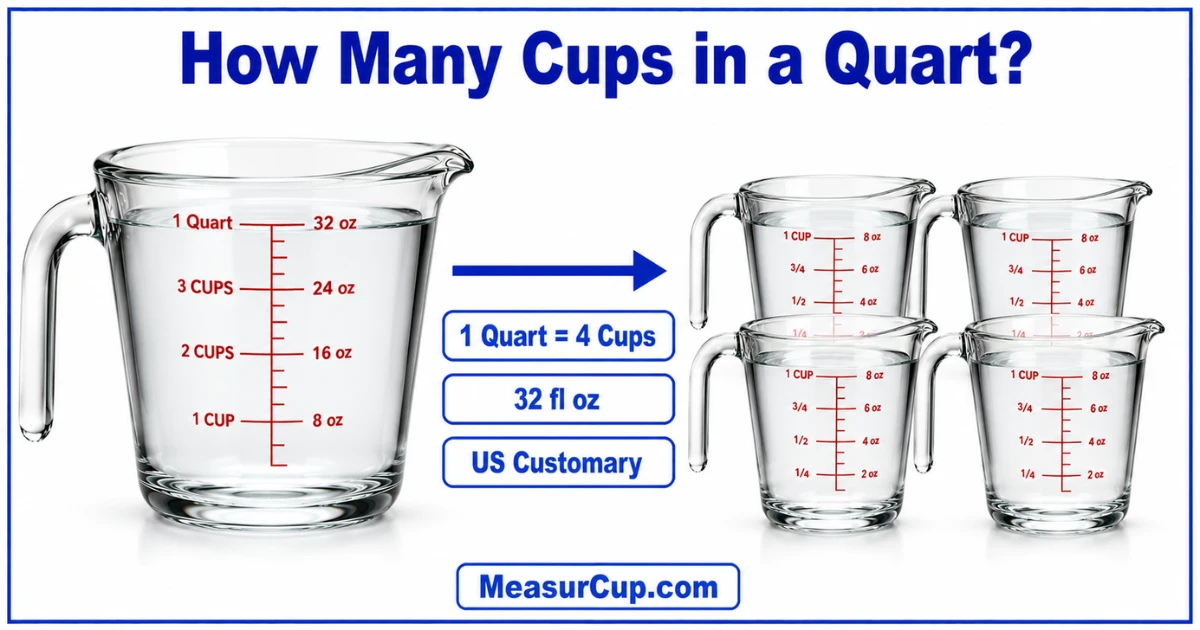
4 cups make 1 quart, which is also 2 pints and 32 fluid ounces. That settles how many cups are in a quart: 2 quarts is 8 cups, 3 quarts is 12 cups, and 4 quarts is 16 cups.
The guide covers a cups, quarts, pints, and fluid ounces chart, the formulas to convert quarts to cups and back, and the difference between a liquid quart and a dry quart. It also shares tips for measuring cups and quarts accurately.
How Many Cups Are in a Quart? Conversion Chart
This is a fixed US customary measurement, so it never changes based on what you’re measuring.
To convert quarts to cups, multiply the number of quarts by 4.
Cups = Quarts × 4
How to Convert Cups to Quarts
To go the other way, divide the number of cups by 4.
Quarts = Cups ÷ 4
How Many Cups in 2 Quarts
2 quarts equal 8 cups. This is a common amount for a medium stockpot of soup or a large pitcher of iced tea.
How Many Cups in 3 Quarts
3 quarts equal 12 cups. This size shows up often in large-batch recipes, like chili, spaghetti sauce, or punch for a party.
How Many Cups in 4 Quarts
4 quarts equal 16 cups, which is also equal to 1 gallon. This is the go-to size for big-batch soups, large ice cream churns, and bulk food storage.
How Many Cups in a Quart of Water
A quart of water equals 4 cups, or 32 fluid ounces. This applies whether you’re filling a water bottle, a recipe, or a pet’s water bowl.
Liquid Quart vs Dry Quart
Not all quarts are equal. The US liquid quart measures 32 fluid ounces, while the US dry quart measures closer to 37.2 fluid ounces, according to the National Institute of Standards and Technology.
I am the admin and author of Measur Cup, researching, verifying, and simplifying weight, length, and unit conversions to provide accurate, easy-to-understand measurement guides for everyday use.